
Few classes of medicine have moved from obscure endocrinology footnote to national conversation as fast as the GLP-1 receptor agonists. In Houston clinics from the Texas Medical Center to strip-mall telehealth storefronts in Katy and Sugar Land, patients now ask for these compounds by name. Yet most people using them, and many prescribing them, could not explain what the drugs actually do inside the body beyond a vague sense that they "curb appetite." This article is an educational deep dive, for research and general-knowledge purposes only, into the real mechanism of GLP-1 receptor agonists: the hormone they imitate, the receptor they bind, the cascade of signals that follow, and where the honest human evidence begins and ends. Nothing here is medical advice or a prescription, and every decision about these compounds belongs with a licensed physician who knows your history.
It helps to start with a plain definition. GLP-1 stands for glucagon-like peptide-1, a small peptide hormone your own gut releases after you eat. A GLP-1 receptor agonist is simply a molecule engineered to bind and activate the same receptor that natural GLP-1 activates, but in a form that resists rapid breakdown so it lasts for days rather than minutes. Semaglutide, tirzepatide, and liraglutide are the three most widely used examples, and all three are FDA-approved for specific indications such as type 2 diabetes and, for some formulations, chronic weight management. Understanding how they work means understanding the elegant physiology they hijack.
The Incretin System: A Hormone Born in the Gut
When food reaches your small intestine, specialized enteroendocrine cells called L-cells sense the arriving nutrients, particularly carbohydrates and fats, and respond by secreting GLP-1 into the bloodstream. GLP-1 belongs to a family of hormones known as incretins, a name that captures their defining job: they amplify the insulin response to a meal. Researchers noticed decades ago that an oral dose of glucose triggers far more insulin release than the same amount of glucose delivered intravenously. The difference is the incretin effect, and GLP-1 along with its cousin GIP (glucose-dependent insulinotropic polypeptide) accounts for most of it. Your gut, in other words, tells your pancreas that food is on the way and to prepare accordingly.
The catch with natural GLP-1 is its breathtakingly short life. An enzyme called dipeptidyl peptidase-4, or DPP-4, circulates throughout the body and clips the active hormone apart within roughly one to two minutes. This is why you cannot simply take GLP-1 itself as a therapy; it would be gone before it did meaningful work. The entire pharmaceutical achievement behind these drugs is chemical: modify the peptide so the receptor still recognizes it, but DPP-4 and the kidneys cannot dispose of it quickly. Liraglutide added a fatty-acid chain that binds to albumin in the blood, stretching its half-life to about thirteen hours and enabling once-daily dosing. Semaglutide refined that strategy further, achieving a half-life near seven days, which is why it is dosed once weekly.
The Receptor and the Signal It Fires
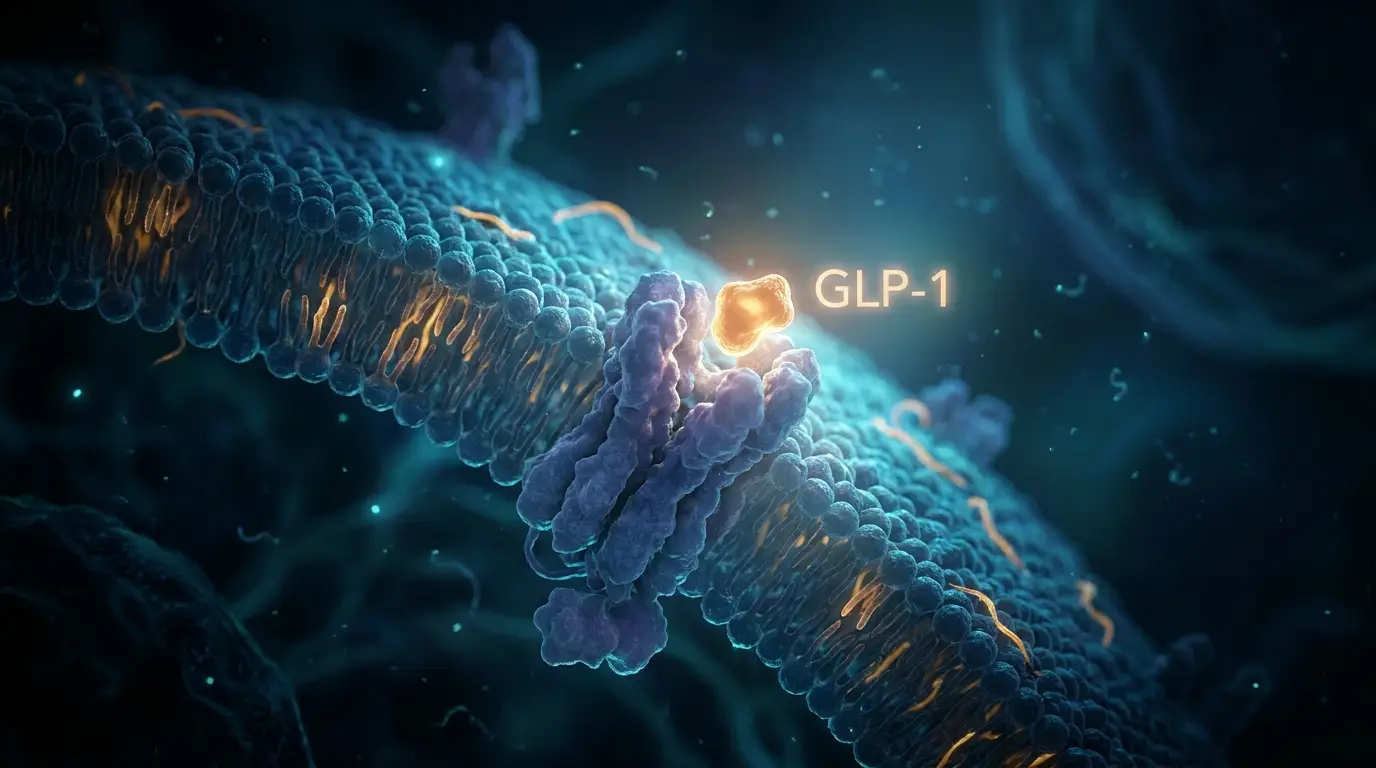
The GLP-1 receptor is a class B G-protein-coupled receptor, a seven-pass transmembrane protein studded on the surface of cells in many tissues: pancreatic beta cells, the stomach, the heart, blood vessels, and critically, several regions of the brain. When an agonist binds the receptor's extracellular domain, the receptor changes shape and couples to a G-protein inside the cell, most importantly one that activates the enzyme adenylate cyclase. Adenylate cyclase manufactures cyclic AMP, a universal second messenger, and rising cyclic AMP activates protein kinase A and a signaling protein called Epac2. The practical consequence in a beta cell is that insulin-containing granules become primed and ready to release.
Here is the feature that makes GLP-1 signaling so clinically useful and comparatively safe: it is glucose-dependent. The pathway amplifies insulin secretion only when blood glucose is already elevated. When your blood sugar is normal or low, the augmenting effect largely switches off. This is why GLP-1 receptor agonists, used on their own, carry a low intrinsic risk of dangerous hypoglycemia compared with older diabetes drugs like sulfonylureas or with insulin itself. The receptor essentially gives the pancreas a smarter, context-aware nudge rather than a blunt command to dump insulin regardless of need.
At the same time, activation of the GLP-1 receptor suppresses the secretion of glucagon, the hormone that tells the liver to release stored glucose. In type 2 diabetes glucagon is often inappropriately high, so damping it helps lower fasting blood sugar. The receptor also slows gastric emptying, meaning food leaves the stomach more gradually. A slower stomach flattens the post-meal glucose spike and, just as importantly, prolongs the physical sensation of fullness. Much of what patients experience as reduced appetite begins right there in the stomach.
The Brain: Where Appetite Is Rewritten
The weight-loss story, however, is written largely in the brain. GLP-1 receptors are densely expressed in the hypothalamus, the ancient control center that regulates hunger and energy balance, and in the hindbrain, particularly a region called the area postrema and the nucleus tractus solitarius. These hindbrain zones sit partly outside the tight blood-brain barrier, so circulating agonist can reach them directly. When GLP-1 receptors in these centers are activated, the net signal is one of satiety: you feel satisfied sooner, you feel full longer, and the drive to seek more food quiets down.
Newer research points to effects on the brain's reward circuitry as well. Many people on these medications describe a fading of what they call "food noise," the intrusive, near-constant mental chatter about eating. This lines up with GLP-1 activity in dopamine-associated reward pathways, which appears to reduce the anticipatory pull of highly palatable, calorie-dense foods. The result is not willpower conjured from nowhere; it is a genuine shift in the underlying neurochemistry of appetite and reward. That said, the reward-pathway picture is still an active area of study, and much of the finest-grained mechanistic detail comes from animal models rather than from human brains, a distinction worth keeping in mind.
Slowed digestion is a real physiological change
One Receptor, Then Two: The Rise of Dual Agonists
For years the field targeted GLP-1 alone. Tirzepatide changed the design by acting on two incretin receptors at once: GLP-1 and GIP. GIP is the other major incretin hormone, and although its role in metabolism is more complex and was historically underappreciated, engaging both receptors together has produced some of the largest weight reductions yet seen in randomized trials of a pharmaceutical. The leading hypothesis is that GIP receptor activity complements GLP-1 by acting on fat tissue and on distinct brain pathways, and may also blunt some of the nausea, though the full mechanistic explanation is still being worked out. Tirzepatide is FDA-approved for type 2 diabetes and, under a separate brand, for chronic weight management.
- Liraglutide: a single GLP-1 receptor agonist with an albumin-binding fatty-acid chain, dosed once daily; FDA-approved for type 2 diabetes and, at a higher dose, for chronic weight management.
- Semaglutide: a longer-acting single GLP-1 receptor agonist dosed once weekly by injection, with an oral tablet version also available; FDA-approved for type 2 diabetes and chronic weight management.
- Tirzepatide: a dual GIP and GLP-1 receptor agonist dosed once weekly; FDA-approved for type 2 diabetes and chronic weight management, and associated with the largest average weight loss in head-to-head trial data to date.
The pipeline is moving quickly beyond even these. Triple agonists that add glucagon-receptor activity, and other multi-receptor peptides, are working through clinical trials. Many of these newer molecules are investigational and are NOT FDA-approved for human use; you may encounter their names in research papers, community forums, or from compounding-adjacent sources, but their long-term safety in people is simply not yet established. Treat unapproved compounds as experimental, because that is exactly what they are.
Key takeaways
- GLP-1 is a natural gut hormone that boosts insulin, suppresses glucagon, slows stomach emptying, and signals fullness to the brain.
- The drugs are chemically modified to resist the DPP-4 enzyme, extending a natural half-life of minutes into hours or days.
- Insulin augmentation is glucose-dependent, which is why these agents carry low intrinsic hypoglycemia risk when used alone.
- Appetite reduction is driven substantially by the brain, including hypothalamic satiety centers and reward pathways, not by willpower.
- Semaglutide and liraglutide target GLP-1 alone; tirzepatide adds GIP for a dual-receptor effect and larger average weight loss.
What the Human Evidence Actually Shows
It is easy to lose the honest signal amid the marketing noise, so here is where the graded evidence stands. The glucose-lowering effect of these agents in type 2 diabetes is supported by large, well-conducted randomized controlled trials and by years of real-world use; this is settled, high-quality human data. The weight-management benefit is likewise supported by robust trials such as the STEP program for semaglutide and the SURMOUNT program for tirzepatide, which showed substantial average reductions in body weight over roughly a year to eighteen months versus placebo. These are not preliminary findings; they are among the strongest efficacy datasets in modern metabolic medicine.
Cardiovascular outcomes deserve special mention because they moved the science from "lowers a number" to "changes what happens to people." A large trial of semaglutide in people with established cardiovascular disease and overweight or obesity, but without diabetes, reported a meaningful reduction in the risk of major adverse cardiovascular events. That is a hard clinical endpoint, and it strengthened the case that these drugs act on more than the scale. Investigators continue to study benefits in kidney disease, sleep apnea, fatty liver disease, and other conditions, and some early results are encouraging. But encouraging is not the same as proven, and a responsible reader distinguishes an established indication from an emerging hypothesis.
Two honest limitations belong in any complete account. First, weight tends to return after the medication is stopped, because the underlying appetite biology reasserts itself; trial data suggest much of the lost weight comes back over the following year without continued treatment or a durable lifestyle scaffold. These are not one-time cures but ongoing therapies for a chronic condition. Second, much of the deepest mechanistic understanding of receptor signaling, reward pathways, and tissue-specific effects rests on animal and cell studies. Those studies are genuinely informative, but they are not the same evidence class as a randomized human trial, and good science writing never blurs that line.
It also helps to understand why the two incretins are not redundant. GIP and GLP-1 evolved to handle overlapping but distinct jobs, and the receptors sit on different tissues. GLP-1 leans heavily on the pancreas, the gut, and the brainstem, while GIP has notable activity in fat tissue and appears to modulate how the body stores and handles lipids and energy. For a long time GIP was viewed skeptically as a metabolic target, with some evidence pointing in unhelpful directions, which is part of why tirzepatide's success surprised many researchers. The lesson embedded in that surprise is a healthy one for any reader: physiology is rarely as simple as a single tidy pathway, and the field revises its models as better human data arrives.
Muscle, Metabolism, and the Details People Miss
A frequently overlooked nuance is what the body loses during rapid weight reduction. When any intervention produces large, fast weight loss, a fraction of that loss is lean mass, including muscle, not just fat. This is not unique to GLP-1 drugs, but their effectiveness makes the issue practically relevant. In the research and clinical-management literature, this is why adequate dietary protein and consistent resistance training are repeatedly emphasized as companions to therapy: to bias the loss toward fat and preserve the metabolically active muscle that supports long-term health. None of this is a prescription; it is context that a supervising physician and, often, a dietitian help translate into a real plan.
Dosing in the real world follows a deliberate escalation. Across the published literature and clinical protocols, these agents are started low and titrated upward over weeks or months, precisely to let the gut adapt and to minimize nausea and other gastrointestinal effects. We mention this only as a reference to how the medications are studied and used under supervision, never as an instruction to follow. There is no responsible version of self-titrating an injectable prescription drug based on an internet article. The specific starting dose, the pace of increase, and the target are individualized medical decisions.
Consistency beats intensity
The Houston Context: Heat, Humidity, and Access
Living on the Gulf Coast adds practical wrinkles that a generic national article ignores. Houston summers are brutally hot and humid, and these medications are peptides that require refrigeration; heat degrades them. A pen left in a car in a Memorial or Pearland parking lot in July, where interior temperatures climb well past what any biologic tolerates, can be compromised long before you notice. The same caution applies to shipping: many Houstonians receive prescriptions by mail from telehealth providers, and a package sitting on a doorstep in Katy or Clear Lake through an afternoon thunderstorm and swelter is a real cold-chain risk. Storage discipline matters more here than in a temperate climate.
Houston also sits inside a large and active medical ecosystem. The Texas Medical Center is among the biggest in the world, and endocrinology, obesity medicine, and cardiometabolic expertise are unusually accessible in this region, whether through major institutions or the many independent clinics scattered across The Woodlands, Sugar Land, the Heights, and the Galleria area. Texas telehealth rules have also made remote prescribing common, and a large compounding landscape has grown up around the branded-drug shortages of recent years. That access is a genuine advantage, but it also means quality varies widely, and the burden of vetting a provider falls partly on the patient.
Compounded is not automatically equivalent
One more local reality is heat-related tolerance itself. Slowed gastric emptying plus reduced appetite can quietly reduce how much people eat and, importantly, drink. In a Houston August, when you are sweating through a walk in the Heights or a Saturday in Galveston, blunted thirst and appetite can make dehydration easier to stumble into than you would expect. Watching fluid and electrolyte intake, especially early in therapy and on the hottest days, is the kind of small, sensible habit that the Gulf Coast climate makes more relevant than it would be almost anywhere else.
Putting the Mechanism Together
Step back and the elegance of the design comes into focus. A GLP-1 receptor agonist is a durable mimic of a natural post-meal hormone. It tells the pancreas to release insulin, but only when glucose is high. It quiets glucagon so the liver stops over-supplying sugar. It slows the stomach so meals release their contents gradually and fullness lasts. And it reaches into the hunger and reward centers of the brain to turn down the volume on appetite and food-seeking. Tirzepatide layers a second incretin signal, GIP, on top of that foundation. None of these actions is magic; each is a specific, traceable piece of physiology that researchers can point to on a signaling diagram.
These drugs do not override your biology through force. They speak your body's own hormonal language a little more clearly, and a little longer, than nature does.
The honest bottom line is that GLP-1 receptor agonists represent a rare case where a mechanism is well understood, the human efficacy data is strong for the approved uses, and the drugs deliver clinically meaningful results, all while real limitations and side effects remain. They are not appetite-suppressant novelties and they are not a cure that lets you forget about food forever. They are chronic-disease therapies that work by borrowing a hormone your own gut already makes. For a Houston reader trying to separate substance from hype, that framing, grounded in mechanism and graded evidence, is the most useful thing to carry away. And every next step, from whether to start to how to store a pen through a Texas summer, is a conversation to have with your own licensed physician.
Frequently asked
What does GLP-1 actually stand for and where does it come from?+
GLP-1 is glucagon-like peptide-1, a hormone your intestinal L-cells release after you eat. It is an incretin, meaning it amplifies your insulin response to a meal, and it also slows digestion and signals fullness to the brain. The drugs are lab-made mimics of this natural hormone.
Why can't you just take natural GLP-1 as a medicine?+
Natural GLP-1 is destroyed within about one to two minutes by an enzyme called DPP-4. The whole pharmaceutical achievement is chemically modifying the peptide so the receptor still recognizes it but the body cannot break it down quickly, extending its life from minutes to hours or days.
Why do these drugs cause less low blood sugar than older diabetes medicines?+
Their insulin-boosting effect is glucose-dependent: the pathway amplifies insulin release mainly when blood glucose is already high, and largely switches off when it is normal or low. This built-in safety feature gives them a lower intrinsic risk of dangerous hypoglycemia than sulfonylureas or insulin when used alone.
How is tirzepatide different from semaglutide?+
Semaglutide activates one receptor, the GLP-1 receptor. Tirzepatide is a dual agonist that activates both the GLP-1 and the GIP receptors. Engaging both incretin pathways has produced some of the largest average weight reductions seen in randomized trials, though the full explanation for the added benefit is still being studied.
Is the appetite reduction just willpower or a placebo effect?+
No. GLP-1 receptors are densely present in brain regions that control hunger and reward, including the hypothalamus and hindbrain. Activating them genuinely shifts appetite neurochemistry, which is why many users describe a real fading of intrusive food cravings rather than simply trying harder.
Does the weight come back if you stop?+
Trial data suggest much of the lost weight tends to return over the following year if the medication is stopped, because the underlying appetite biology reasserts itself. These are ongoing therapies for a chronic condition, not one-time cures, which is an important expectation to set with your physician.
Are all GLP-1 style peptides FDA-approved?+
No. Semaglutide, tirzepatide, and liraglutide are FDA-approved for specific indications such as type 2 diabetes and chronic weight management. Many newer triple agonists and experimental multi-receptor peptides you may read about are investigational and NOT approved for human use, with long-term safety not yet established.
What should Houston users know about storage in the heat?+
These are peptides that require refrigeration and degrade in heat. A pen left in a hot car or a package sitting on a doorstep through a Gulf Coast afternoon can be compromised. Cold-chain storage, and prompt refrigeration of mail-order shipments, matters more in Houston's climate than in a temperate one.
Is compounded GLP-1 the same as the branded product?+
Not necessarily. Compounded products are not reviewed by the FDA for safety, effectiveness, or manufacturing quality the way approved branded drugs are, and potency and purity can vary between pharmacies. Any decision about these medications should go through a licensed Texas physician and a legitimate, verifiable pharmacy. This site does not sell peptides.
References
- Wilding JPH et al. — Once-Weekly Semaglutide in Adults with Overweight or Obesity (STEP 1)N Engl J Med 2021;384:989-1002
- Jastreboff AM et al. — Tirzepatide Once Weekly for the Treatment of Obesity (SURMOUNT-1)N Engl J Med 2022;387:205-216
- Lincoff AM et al. — Semaglutide and Cardiovascular Outcomes in Obesity without Diabetes (SELECT)N Engl J Med 2023;389:2221-2232
- Marso SP et al. — Semaglutide and Cardiovascular Outcomes in Type 2 Diabetes (SUSTAIN-6)N Engl J Med 2016;375:1834-1844
- U.S. FDA — Medications Containing Semaglutide Marketed for Type 2 Diabetes or Weight LossU.S. Food and Drug Administration