
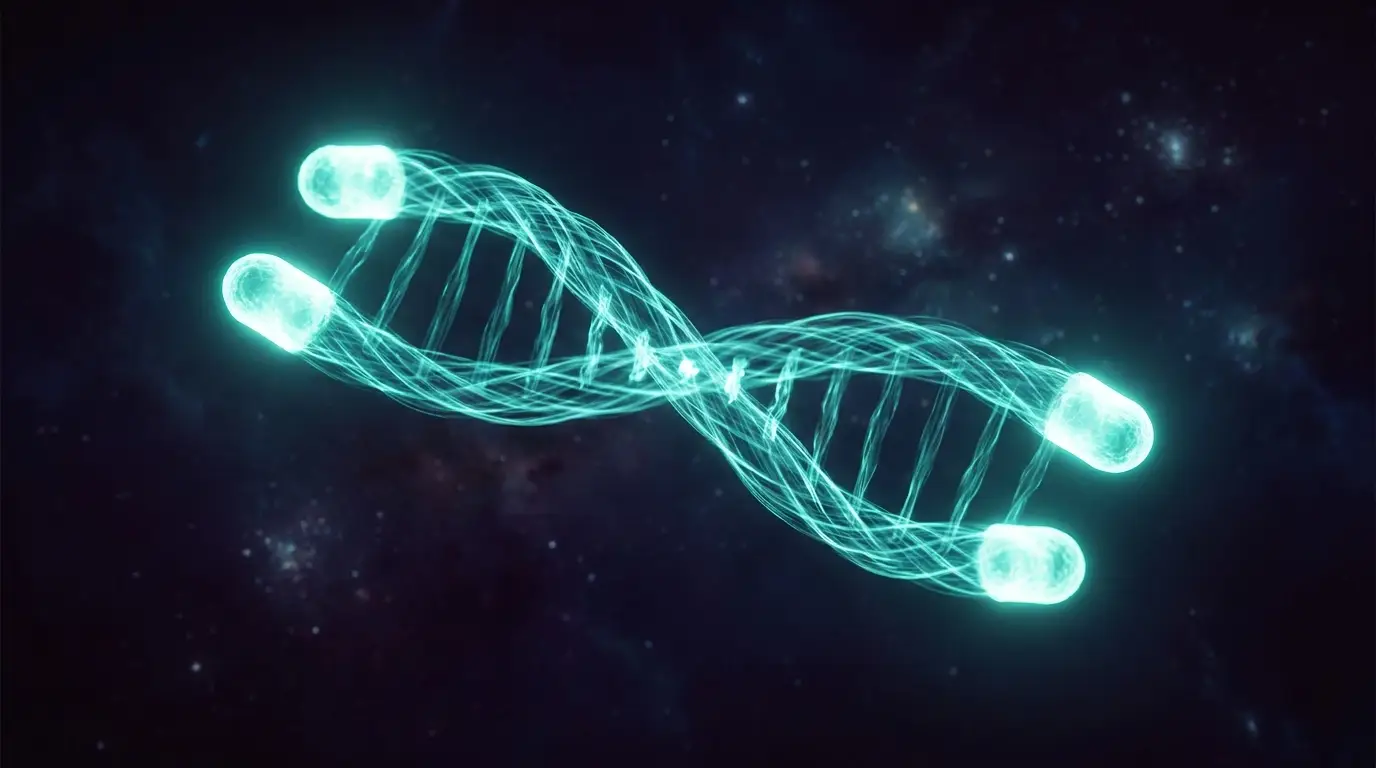
Epitalon
Epithalon · AEDG peptide · Ala-Glu-Asp-Gly
A four-amino-acid pineal peptide claimed to activate telomerase — bold claims, mostly Russian data.
Class
Synthetic tetrapeptide (pineal Epithalamin fragment)
Half-life
Short
Evidence
Limited human data
Limited human data
Small open-label studies, case series, or trials in a narrow population. Directionally informative, not conclusive.
Overview
Epitalon is a synthetic tetrapeptide based on Epithalamin, a pineal gland extract studied for decades in Russian gerontology. Its most striking claim is telomerase activation — the enzyme that maintains the protective caps on chromosomes, whose shortening is a hallmark of cellular aging.
Russian research groups, principally around Vladimir Khavinson, reported that Epitalon lengthened telomeres in human cell cultures and, in long-running cohort studies, was associated with reduced mortality and improved health markers in older adults. It has also been reported to normalise melatonin rhythms via its pineal action.
The Western scientific community treats these claims cautiously: the studies are largely from a single research lineage, often decades old, and have not been independently replicated to modern standards. Telomerase activation is also double-edged, since it is a feature of many cancers. It is not FDA approved.
How it works
- Reported to activate telomerase, maintaining or lengthening telomeres in cell culture.
- Modulates pineal function and melatonin secretion, supporting circadian regulation.
- Antioxidant and gene-expression-modulating effects reported in Russian studies.
- Proposed neuroendocrine 'reset' toward a younger regulatory profile.
What the research shows
Researched effects
- Reported telomere lengthening in human somatic cell cultures
- Associations with reduced mortality in long-term Russian cohort studies
- Reported normalisation of melatonin and circadian rhythm
- Antioxidant effects in animal models
Limitations & what it won't do
- Evidence comes largely from a single Russian research lineage and is not independently replicated.
- Telomerase activation carries a theoretical cancer-promotion concern.
- Human dosing protocols are not standardised.
- Not FDA approved.
Dosing protocols
These ranges reflect published trials and community protocols. They are reference information, not a prescription. Doses are per injection unless noted.
Cyclical longevity protocol (community)
5–10 mgRussian protocols typically use short annual courses rather than continuous dosing. Documented for reference.
Reconstitution & measuring your dose
Handling
- Typical vial sizes
- 10 · 50 mg
- Suggested BAC water
- 2 mL
- Storage
- Lyophilised powder refrigerated at 2–8 °C, protected from light.
- After reconstitution
- Reconstituted: approximately 30 days refrigerated.
Why 2 mL? A 10 mg vial in 2 mL yields 5 mg/mL — a 5 mg dose lands on 100 units of a U-100 syringe. For a 10 mg dose, reconstitute a 20 mg vial in 2 mL instead.
Dose calculator
Draw to
20units
= 0.2 mL · 250 mcg per unit
Concentration
25000 mcg/mL
Doses per vial
10
Side effects
Common
- Injection-site irritation
- Generally reported as well tolerated
- Drowsiness with evening dosing
Serious / rare
- Unknown — no rigorous Western safety data
- Theoretical cancer concern from telomerase activation
Contraindications & interactions
Do not use if you have
- Active cancer or current oncology treatment
Telomerase activation is a mechanism cancers use to become immortal. Active malignancy is a contraindication.
- Pregnant, breastfeeding, or trying to conceive
No pregnancy safety data.
Use caution if you have
- Past cancer diagnosis (in remission)
Given the telomerase mechanism, discuss with oncology before use with any cancer history.
What to monitor
- General health markers
- Cancer screening appropriate for age given the mechanism
Commonly combined with
Articles that mention Epitalon
Epitalon: common questions
Is Epitalon approved for human use?
Most research peptides, including Epitalon, are not FDA-approved for general human use and are sold as research chemicals "not for human consumption." Check the legal-status and evidence badges above, and consult a licensed physician — this page is educational only.
How strong is the evidence for Epitalon?
On this site Epitalon is graded "Limited human data". Small open-label studies, case series, or trials in a narrow population. Directionally informative, not conclusive. We grade every claim so you can weigh it honestly rather than by hype.
How is Epitalon reconstituted and dosed?
See the protocols and reconstitution details above for reference ranges, then use the dose calculator to convert a vial's mg, your bacteriostatic-water volume, and target dose into exact insulin-syringe units. Dosing shown is a reference, not a recommendation.
What should I screen for before considering Epitalon?
Run your goals, medical history, and current medications through the assessment — it flags contraindications and interactions and will hard-stop unsafe matches — and confirm everything with a licensed physician. Any use is at your own risk.
References
- Khavinson VK et al. — Epithalon peptide induces telomerase activity and telomere elongationBull Exp Biol Med 2003;135:590-592
Research & educational information only — not medical advice.
You must be 18 or older to use this site. The peptides described are presented as research chemicals intended for research purposes only. Most are not approved by the FDA for human use. Dosing ranges reflect what has appeared in the scientific literature or community protocols and are not prescriptions. Nothing here replaces evaluation by a licensed physician who knows your full medical history.
Want to know if Epitalon fits your goals and history?
The assessment cross-checks your medical history and medications against this and every other compound before it recommends anything.
Start the assessment