
Almost every research peptide vial in circulation carries some version of the same small print: "for research purposes only," "not for human consumption," "laboratory use only." It is easy to read those words as a wink, a legal fig leaf that everyone knows to ignore. That reading is a mistake, and understanding why is one of the most important things a person can learn before spending another minute thinking about this category. The disclaimer is not decoration. It is an accurate description of what the product actually is, how it was made, what was and was not verified about it, and which body of law it lives under. This article unpacks the phrase honestly: what "research only" signals about purity, sourcing, and testing, why those three words carry real weight, and how the picture looks specifically from Houston, a city built around one of the largest medical complexes on earth. Nothing here is a recommendation to obtain or use any compound, and this site does not sell peptides.
Start with the honest framing that anchors everything at HTX Peptide. The overwhelming majority of research peptides discussed online and in wellness circles are not approved by the U.S. Food and Drug Administration for human use. A small group is approved, but only for narrow indications: semaglutide and tirzepatide for type 2 diabetes and chronic weight management, liraglutide for similar uses, tesamorelin for HIV-associated lipodystrophy, and PT-141, known generically as bremelanotide, for a specific form of low sexual desire. Everything else, including widely discussed names like retatrutide in its still-investigational state, melanotan-2, LL-37, BPC-157, and the growth hormone secretagogues, sits in a research-only category with no FDA sign-off for treating any condition in people. That distinction is not a technicality. It is the difference between a substance whose identity, dose, purity, and safety have been established through regulated manufacturing and clinical trials, and one where none of that has happened.
What "Research Purposes Only" Actually Means in Law
The phrase has a specific regulatory function. Research chemicals and laboratory reagents are sold under an exemption that assumes they will be used in a controlled scientific setting, by people who understand they are handling uncharacterized material, and never introduced into a human or animal body. A reagent-grade compound is manufactured to be adequate for bench experiments, not to the vastly stricter standards that govern injectable medicines. When a vendor labels a product "for research use only," they are placing it in that exempt category and, in the same stroke, stating that it is not a drug, not a supplement, and not a food. It has not been reviewed for safety or efficacy, it carries no approved indication, and it comes with no dosing instructions because there is no approved dose to instruct.
This is why you will never see a legitimate research supplier print human dosing on a label. Doing so would recharacterize the product as an unapproved new drug and expose the seller to a very different tier of federal liability. The disclaimer, in other words, is doing real legal work. It is the boundary line that lets a substance be sold at all outside the pharmaceutical system. For the buyer, that same line is a warning: everything on the far side of it, including the assumption that the vial contains what the label says in the amount the label claims, is unverified. The words are not telling you the rules do not apply. They are telling you the rules never engaged in the first place.
The Disclaimer Is a Statement of Fact, Not a Loophole
Purity Is Four Questions, Not One
People tend to collapse "is it good?" into a single yes-or-no about purity. In reality, the quality of an injectable peptide breaks into at least four separate questions, each answered by a different test, and a research vial usually has a verified answer to none of them. The first is identity: is the molecule in the vial actually the peptide named on the label, with the correct amino acid sequence and structure? The second is chemical purity: what fraction of the material is the intended peptide versus truncated chains, deletion sequences, oxidation and deamidation byproducts, and residual synthesis reagents? The third is sterility: is the product free of viable bacteria and fungi, which matters enormously for anything that would be injected. The fourth is endotoxin content: even a sterile product can contain bacterial cell-wall fragments called endotoxins that survive sterilization and can trigger fever, inflammation, and worse when they enter the bloodstream.
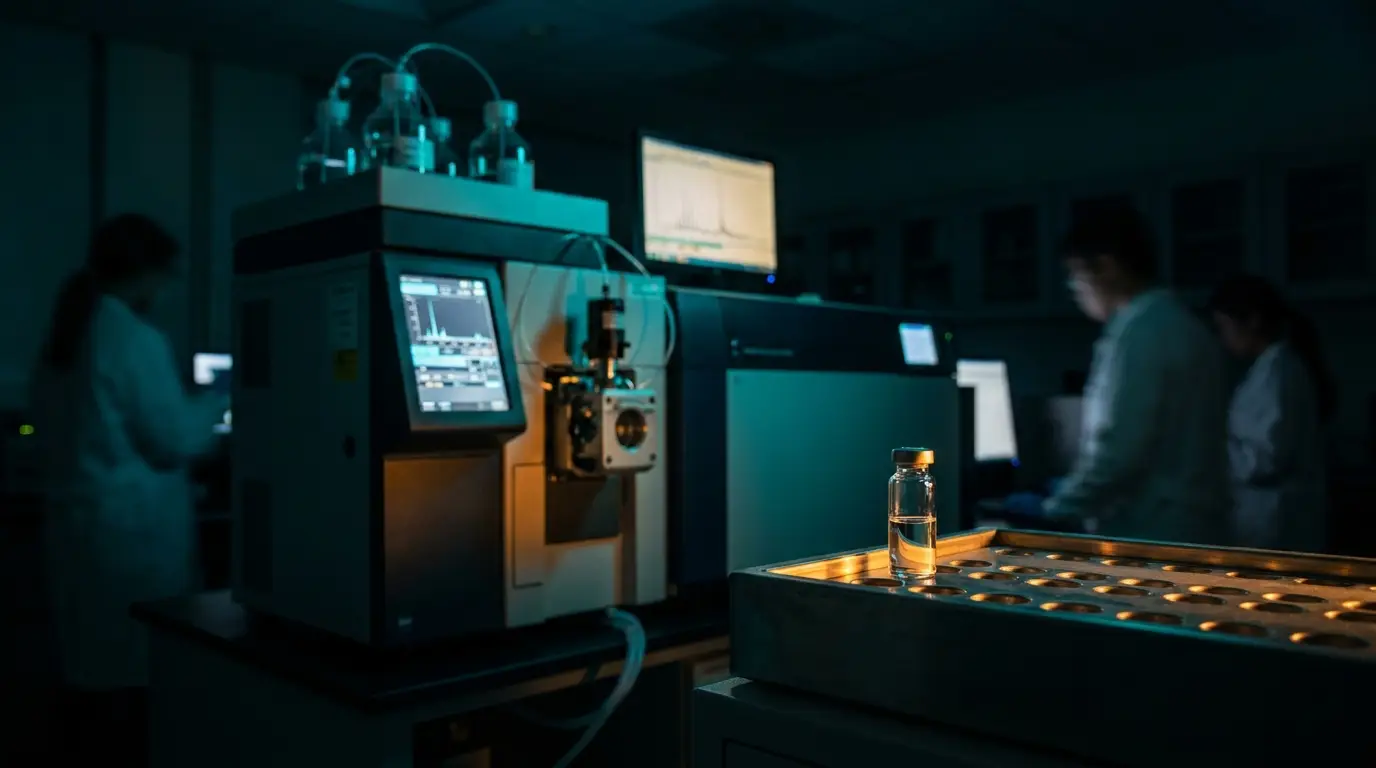
Each of these requires real analytical infrastructure to answer. Identity and chemical purity are typically assessed with high-performance liquid chromatography paired with mass spectrometry, techniques that separate the components of a sample and weigh them at the molecular level. Sterility testing requires culturing the product under controlled conditions. Endotoxin testing uses specialized assays derived from horseshoe crab blood or recombinant equivalents. A pharmaceutical manufacturer runs all of these under a quality system with documented procedures, calibrated instruments, and independent oversight. A research-chemical operation may run some, all, or none of them, and the buyer generally cannot tell which from the outside. A powder that is ninety-nine percent pure by mass and a powder that is seventy percent pure with a fever-inducing endotoxin load can look identical in the vial. Appearance proves nothing.
Sterility and Endotoxins Are Injection-Specific Dangers
The Certificate of Analysis Problem
Ask about purity in any peptide forum and someone will point to the certificate of analysis, or COA, as the answer. A COA is a document, usually a page or two, reporting the results of identity and purity testing on a batch, often with a chromatography trace and a mass-spectrometry readout attached. When it is genuine, current, and tied to the actual lot in your hand, a COA is genuinely useful information. The problem is that a consumer has essentially no way to verify any of those conditions. A COA is a PDF. It can be copied from another batch, edited, generated for a lot that bears no relationship to what shipped, or fabricated wholesale. The testing laboratory named on it may not exist, may not have run the test, or may not have received a representative sample.
Even a real COA has limits worth understanding. Most COAs report chemical purity and identity but say nothing about sterility or endotoxin content, the two properties that matter most for injection safety. A COA showing ninety-eight percent purity tells you nothing about whether the vial is sterile. It is also a snapshot of a sample, not a guarantee about every vial in a batch, and it says nothing about what happened to the product after testing, during shipping through a Houston summer, or on a doorstep in Katy. The document creates a powerful impression of rigor, which is precisely why it is so easily weaponized. Treating a COA as proof of safety is one of the most common and most dangerous errors in this space.
Read a COA as a Claim, Not a Guarantee
Sourcing: The Chain Nobody Can See
Sourcing is the story of where a compound came from and every hand it passed through before reaching an end user, and in the research-chemical world that story is almost entirely opaque. A large share of research peptides are synthesized at overseas facilities, sold to intermediaries, relabeled by distributors, and marketed under brand names that reveal nothing about the underlying manufacturer. A single well-known consumer-facing label may source from several factories over time, with varying quality, and the buyer sees none of that turnover. There is no requirement to disclose the manufacturer, no chain-of-custody documentation, and no recall mechanism if a bad batch goes out. When something goes wrong, there is frequently no one to hold accountable and no way to trace which link failed.
Contrast that with how a regulated medicine reaches a patient. An FDA-registered manufacturer operates under current good manufacturing practice, a legally enforceable framework covering everything from raw-material qualification to environmental monitoring to batch-record review. Product moves through licensed distributors under track-and-trace rules designed to keep counterfeits out of the supply. A pharmacy verifies the source. If a defect surfaces, a recall can pull specific lots. Every link is identifiable and accountable. The research-chemical chain has none of this scaffolding, which is not an incidental gap but the defining feature of operating outside the pharmaceutical system. The low price and easy access that make research vials attractive are the direct economic consequence of skipping all of that infrastructure.
Key takeaways
- "Research only" is an accurate legal description: the product was never made, tested, or released as a medicine for people.
- Quality is at least four separate questions, identity, chemical purity, sterility, and endotoxins, and a research vial usually verifies none of them.
- A certificate of analysis is an unverifiable claim about one sample and typically ignores sterility and endotoxins entirely.
- Research-chemical sourcing is opaque by design, with no disclosed manufacturer, no chain of custody, and no recall mechanism.
- The regulated pharmaceutical chain exists precisely to close these gaps, which is why it costs more and moves slower.
How Real Peptide Testing Works
It helps to understand what genuine quality control involves, both to appreciate what a research vial lacks and to read testing claims with a critical eye. Identity confirmation typically pairs mass spectrometry, which measures the molecular weight of the peptide and its fragments to confirm the sequence, with amino acid analysis. Chemical purity is most often reported as a percentage from reverse-phase high-performance liquid chromatography, which separates the intended peptide from related impurities and integrates the area under each peak. A purity figure only means something in context: purity by what method, against which impurities, with what detection sensitivity. A number without a method is close to meaningless.
Sterility and endotoxin testing belong to a different discipline entirely, microbiological quality control, and are the tests most often absent from research-chemical documentation. Sterility testing incubates samples in growth media to detect viable organisms, a process that takes days and requires aseptic technique to avoid false results. Endotoxin testing, historically the Limulus amebocyte lysate assay and increasingly recombinant factor C methods, quantifies bacterial endotoxin down to tiny thresholds because the injectable limits are extremely low. A legitimate sterile-injectable manufacturer also validates its filling process, monitors its cleanroom environment, and tests for particulates. The distance between that operation and a facility that synthesizes a powder and ships it in a plain vial is enormous, and it is exactly the distance the phrase "research purposes only" is pointing at.
The Houston and Gulf Coast Context
Houston is an unusually instructive place to think about all of this, because the city is organized around the Texas Medical Center, the largest medical complex in the world by many measures. Within a few square miles, institutions run some of the most rigorous quality-controlled operations anywhere: sterile compounding, biologics handling, clinical-trial pharmacies, and cold-chain logistics engineered to standards that make a research-chemical shipment look like what it is. That concentration of expertise sets a useful mental benchmark. The gap between how the medical center handles an injectable and how a research vial arrives on a porch is the gap this entire article is about, and living in Houston means that professional standard is never far away as a point of comparison.
The Gulf Coast climate adds its own layer to the sourcing and purity conversation. Even a genuinely high-quality peptide can be degraded by the conditions between the manufacturer and the end user, and Houston's environment is punishing. Summer heat routinely turns a parked car in the Galleria or a doorstep in Sugar Land into an oven, humidity hangs high for months, and hurricane season brings multi-day power outages that threaten any refrigerated product. A research-chemical shipment carries no guarantee about how it was handled in transit, and once it lands in a Pearland or Clear Lake driveway in August, whatever quality it started with is at the mercy of the weather. The regulated alternative bakes cold-chain accountability into the process; the research-chemical route leaves it to chance and a foam cooler.
Use the Texas Medical Center as Your Standard
The Regulated Alternative Houstonians Actually Have
None of this means the only options are an unregulated vial or nothing. Texas has a large, active telehealth market, and Houston sits at the center of it. For the FDA-approved medications, particularly the GLP-1 agents used in weight management, many residents work with licensed prescribers and licensed pharmacies, including compounding pharmacies that prepare medications to order under state and federal oversight. That route is a categorically different thing from a research vial. A compounding pharmacy sources active ingredients from FDA-registered suppliers, works from verified certificates for those ingredients, prepares products under controlled conditions, labels them with real dosing and storage instructions, and stands behind what it dispenses. A pharmacist and a physician are accountable, reachable, and licensed.
This distinction matters because it reframes the whole purity-and-sourcing question. Inside the regulated system, identity, sterility, endotoxins, labeling, and cold-chain handling are somebody's professional and legal responsibility. Outside it, they are the buyer's problem and, more often, the buyer's blind spot. For anyone in Houston curious about a peptide, the constructive move is not to hunt for a better research vendor or a more convincing COA. It is to bring the interest to a physician who can distinguish an approved medication with real human evidence from an investigational or research-only compound, explain what is genuinely known, and, where appropriate, route to a legitimate pharmacy. Clinics around the Texas Medical Center and telehealth providers across the Woodlands, Memorial, the Heights, and beyond operate within that system, and it exists precisely so that individuals do not have to personally guarantee the quality of an injectable.
The label does not say "research only" to insult your intelligence. It says so because no one tested it for yours.
Evidence Grading: What We Actually Know
Consistent with how HTX Peptide approaches every topic, it is worth being explicit about the strength of evidence behind these claims. The regulatory meaning of "research use only," the existence and function of good manufacturing practice, and the analytical methods used to establish identity, purity, sterility, and endotoxin content are all well-documented, high-confidence facts drawn from established pharmaceutical science and public regulatory frameworks. That injecting non-sterile or high-endotoxin material can cause serious harm is likewise well established in the medical literature and in documented outbreaks tied to compounded and contaminated injectables. These are not speculative points.
What is genuinely uncertain, and uncertain by design, is the quality of any specific research vial. Because the category operates outside regulated testing and disclosure, there is no reliable population-level data on how often research peptides are underdosed, misidentified, contaminated, or degraded, only scattered independent analyses and anecdote. That absence of data is itself the point: the phrase "research purposes only" marks the boundary beyond which the systems that would generate trustworthy quality data simply do not operate. Where robust human evidence does exist, as with the approved GLP-1 medications studied in large randomized trials, it applies to those specific, regulated products and their approved uses, not to look-alike research compounds sharing a name.
Finally, nothing in this article is a dose, a protocol, or a prescription. Where reference ranges appear anywhere in peptide discussion, they describe what has been observed or reported in the literature and in community settings, not what anyone should do, and they are meaningless without the manufacturing and testing assurances that make a dose safe to administer. The gap between a reference range and a personal decision is filled by a licensed physician who knows your history and can weigh the substantial unknowns, and that is a gap no article, and certainly no certificate of analysis, can close.
The takeaway is simple to state and worth taking seriously. "For research purposes only" is not a technicality to route around; it is the truest sentence on the label. It tells you the product was never built, tested, or released as a medicine, that its purity and sterility are unverified, that its sourcing is opaque, and that no one is accountable for what it does inside a human body. In a city organized around world-class medicine, the contrast could not be clearer. Understand the science, respect the boundary those three words describe, keep the FDA-approval distinctions straight, and let a qualified Houston professional make the calls that matter. This piece is for adults 18 and older, is educational only, and offers no sourcing or purchasing guidance of any kind.
Frequently asked
Does "for research purposes only" just mean the seller is covering themselves legally?+
It does serve a legal function, but it is also literally true. The phrase places a product in the research-chemical category, which is exempt from the manufacturing, testing, and approval requirements that govern medicines. That means the product was never made or verified as something safe to put in a person. The disclaimer is not a wink to ignore; it is an accurate statement that no regulated entity stands behind the vial's identity, purity, or safety for human use.
What does a purity percentage on a peptide actually tell me?+
Less than it appears to. A purity figure, usually from high-performance liquid chromatography, describes what fraction of a sample is the intended peptide versus related impurities, by a particular method against particular impurities. It says nothing about sterility or endotoxin content, the two properties that matter most for injection safety, and it is a snapshot of one sample, not a guarantee for every vial or for how the product was handled afterward. A number without a stated method is close to meaningless.
Can I trust a certificate of analysis (COA)?+
A genuine, current COA tied to the actual lot is useful information, but a consumer has no practical way to verify any of those conditions. A COA is a PDF that can be copied, edited, fabricated, or attached to the wrong batch, and the named lab may not have tested the product you received. Most COAs also omit sterility and endotoxin testing entirely. Read any COA as an unverifiable claim about one sample, not as proof the vial in your hand is safe.
What is the difference between chemical purity and sterility?+
They are entirely separate questions answered by different tests. Chemical purity asks whether the material is the correct molecule and how much of it is impurities, measured by chromatography and mass spectrometry. Sterility asks whether the product is free of viable bacteria and fungi, measured by culturing it over days. A vial can be the right molecule at high chemical purity and still be non-sterile or loaded with fever-inducing endotoxins, which is dangerous for anything injected.
Are the peptides in this article FDA-approved?+
Most are not. The large majority of research peptides, including retatrutide in its investigational state, melanotan-2, LL-37, and BPC-157, are not FDA-approved for human use. A small group is approved only for specific indications: semaglutide, tirzepatide, and liraglutide for diabetes and weight management, tesamorelin for HIV-associated lipodystrophy, and PT-141 (bremelanotide) for a specific sexual desire disorder. This article is educational and does not recommend use of any of them.
Why is research-peptide sourcing considered so opaque?+
Because the chain is intentionally hidden and unregulated. Many research peptides are synthesized overseas, sold to intermediaries, relabeled by distributors, and marketed under brand names that reveal nothing about the manufacturer, which may change over time. There is no disclosed source, no chain-of-custody documentation, and no recall mechanism. When a bad batch goes out, there is typically no one accountable and no way to trace which link failed, which is the opposite of how regulated medicines move through licensed, traceable distribution.
Is there a regulated way to explore peptides in Houston?+
For the FDA-approved medications, yes. Texas has a large telehealth market, and many Houston residents work with licensed prescribers and licensed pharmacies, including compounding pharmacies operating under state and federal oversight, particularly for the approved GLP-1 agents. That route involves verified ingredient sourcing, controlled preparation, real labeling, and a pharmacist and physician who are accountable. It is categorically different from an unregulated research vial. The right first step is a conversation with a licensed physician, not a search for a better vendor.
Does Houston's climate affect peptide quality?+
Yes, on top of everything else. Even a genuinely high-quality peptide can be degraded by heat, humidity, and temperature swings, and the Gulf Coast is punishing: summer cabin temperatures in a parked car exceed safe ranges within minutes, humidity stays high for months, and hurricane season brings multi-day outages. A research-chemical shipment carries no guarantee about transit handling, and once it sits on a Houston-area doorstep in August, whatever quality it started with is at the mercy of the weather.
Is any of this medical advice I can act on?+
No. This article is educational and for adults 18 and older only. It is not medical advice, not a prescription, and not sourcing guidance, and this site does not sell peptides. Questions about purity, sourcing, testing, and whether any compound is appropriate belong with a licensed physician or pharmacist who knows your individual situation and can distinguish approved medications with real human evidence from research-only compounds.
References
- U.S. FDA — Compounding and the FDA: Questions and AnswersU.S. Food and Drug Administration
- U.S. Pharmacopeia — Compounding Standards (USP General Chapters <795>/<797>)United States Pharmacopeia
- Kauffman CA et al. — Fungal Infections Associated with Contaminated Methylprednisolone InjectionsN Engl J Med 2013;368:2495-2500
- World Anti-Doping Agency — The Prohibited List (International Standard)WADA (current edition)
- Jastreboff AM et al. — Triple-Hormone-Receptor Agonist Retatrutide for Obesity (Phase 2)N Engl J Med 2023;389:514-526