If you have ever opened a small glass vial of white, cotton-like peptide powder and wondered what on earth you are supposed to do next, you are not alone. Reconstitution, the process of turning a freeze-dried powder back into a measurable liquid, is the single most common point of confusion for first-time readers in Houston and across the Gulf Coast. It is also the step where small mistakes quietly compound: a rushed calculation, a warm car, a contaminated stopper. This guide walks through the concepts slowly and carefully, in plain language, so that the mechanics stop feeling mysterious. It is written for education and research purposes only. Nothing here is a prescription, a dosing instruction, or a substitute for a licensed physician who knows your history.
Before we go a single step further, the honest framing: the overwhelming majority of peptides people discuss in online communities, BPC-157, ipamorelin, and many others, are not approved by the U.S. Food and Drug Administration for human use. A handful are approved, but only for narrow, specific indications, semaglutide and tirzepatide for metabolic conditions, tesamorelin for a particular HIV-associated fat condition, PT-141 (bremelanotide) for a specific sexual-health diagnosis, liraglutide in its own lane. Everything else sits in a research-chemical gray zone. That distinction is not pedantic. It changes how seriously you should treat every number, every source, and every claim you read, including the ones on this page.
What Reconstitution Actually Is
Peptides are fragile molecules. To ship and store them without degradation, manufacturers freeze-dry them into a stable powder through a process called lyophilization. That powder is not usable as-is, it cannot be measured in fractions of a milligram by eye, and it cannot be drawn into a syringe. Reconstitution is simply the act of adding a sterile liquid back to the powder so it dissolves into a solution of known concentration. Think of it like reconstituting powdered infant formula or a freeze-dried camping meal, except the margins are far tighter and sterility is paramount.
The liquid of choice in most community and clinical protocols is bacteriostatic water: sterile water containing roughly 0.9 percent benzyl alcohol, a mild preservative that suppresses bacterial growth so a multi-use vial can be drawn from over several days or weeks. This is different from plain sterile water for injection (no preservative, intended for single use) and completely different from tap, distilled, or filtered water, none of which are sterile and none of which belong anywhere near a peptide vial. The benzyl alcohol is what lets you return to the same reconstituted vial day after day without it becoming a bacterial soup.
Bacteriostatic vs. sterile water
The One Idea That Trips Everyone Up: Concentration
Here is the concept that causes more confusion than any other, and it is worth reading twice. The amount of peptide in the vial is fixed by the manufacturer, it might be 5 milligrams, or 10 milligrams. But the concentration of your final solution, how much peptide sits in each unit of liquid, depends entirely on how much water you add. Add a little water and the solution is concentrated. Add a lot of water and the same peptide is dilute. Neither is right or wrong in the abstract, but they produce completely different markings on your syringe for the same intended amount.
A worked example makes this concrete. Suppose a vial contains 5 milligrams of peptide. If you add 2 milliliters of bacteriostatic water, the concentration becomes 2.5 milligrams per milliliter. On a standard insulin syringe, which is marked in 100 units per milliliter, that means every 10 units on the syringe holds 0.25 milligrams, or 250 micrograms. Now take that same 5 milligram vial and add 5 milliliters of water instead. The concentration drops to 1 milligram per milliliter, and now every 10 units holds only 0.1 milligrams, or 100 micrograms. Same vial, same peptide, wildly different syringe markings, purely because the water volume changed.
This is why you cannot simply copy a stranger's unit number from a forum. Their vial size and their water volume may be nothing like yours. The only number that transfers between people is the reference range expressed in micrograms or milligrams of peptide, and even that is only a range seen in literature and community protocols, never a personalized prescription. The arithmetic that converts micrograms into syringe units is yours to do carefully, ideally checked by the licensed clinician overseeing you.
Do the math slowly, then check it twice
What You Gather Before You Start
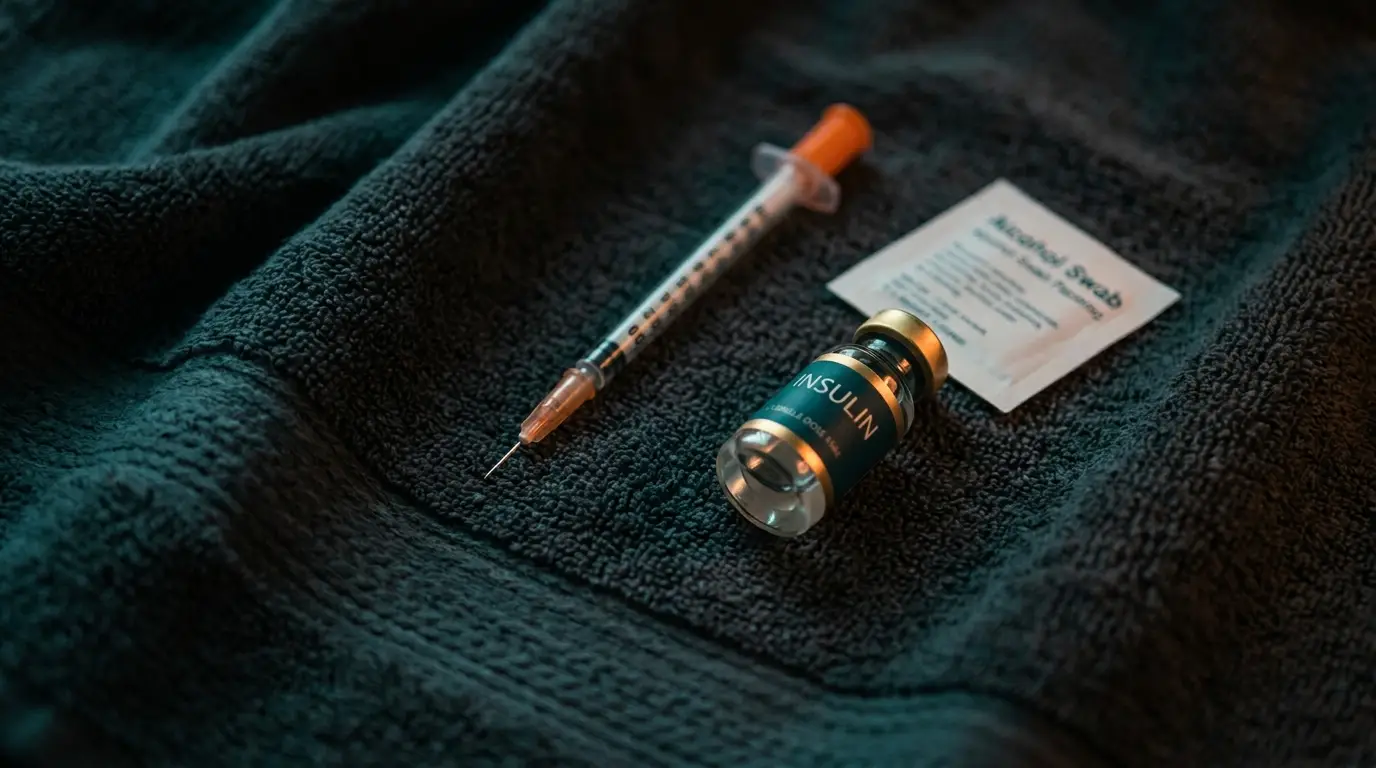
Reconstitution rewards preparation. Assembling everything in advance means you are not fumbling with a half-opened vial and contaminated hands. A typical setup includes the lyophilized peptide vial, a vial of bacteriostatic water, alcohol swabs, a clean flat work surface, a syringe appropriate to the volume of water you plan to draw, and a separate, smaller syringe for eventual measured draws. Many people also keep a small notebook or a note on their phone to record the vial size, the water volume, the resulting concentration, and the date of reconstitution. That last detail matters more than it seems, because reconstituted peptides have a limited shelf life.
- Lyophilized peptide vial (check that the powder or disc is intact and the seal is undisturbed).
- Bacteriostatic water, sealed, within its own expiration date.
- Alcohol swabs, enough to wipe every stopper you pierce, every single time.
- A clean, uncluttered work surface wiped down before you begin.
- Appropriate syringes for both drawing the diluent and later measuring.
- A written log for vial size, water added, concentration, and the reconstitution date.
The Step-by-Step Sequence
With everything laid out, the physical process is unhurried and deliberate. First, wash your hands thoroughly and let the peptide vial come to a stable room temperature if it has been refrigerated, condensation on a cold vial is both a contamination and a moisture concern. Wipe the rubber stopper of both the peptide vial and the bacteriostatic water vial with fresh alcohol swabs, and let them air dry rather than blowing on them. Never touch the cleaned stopper with a finger afterward.
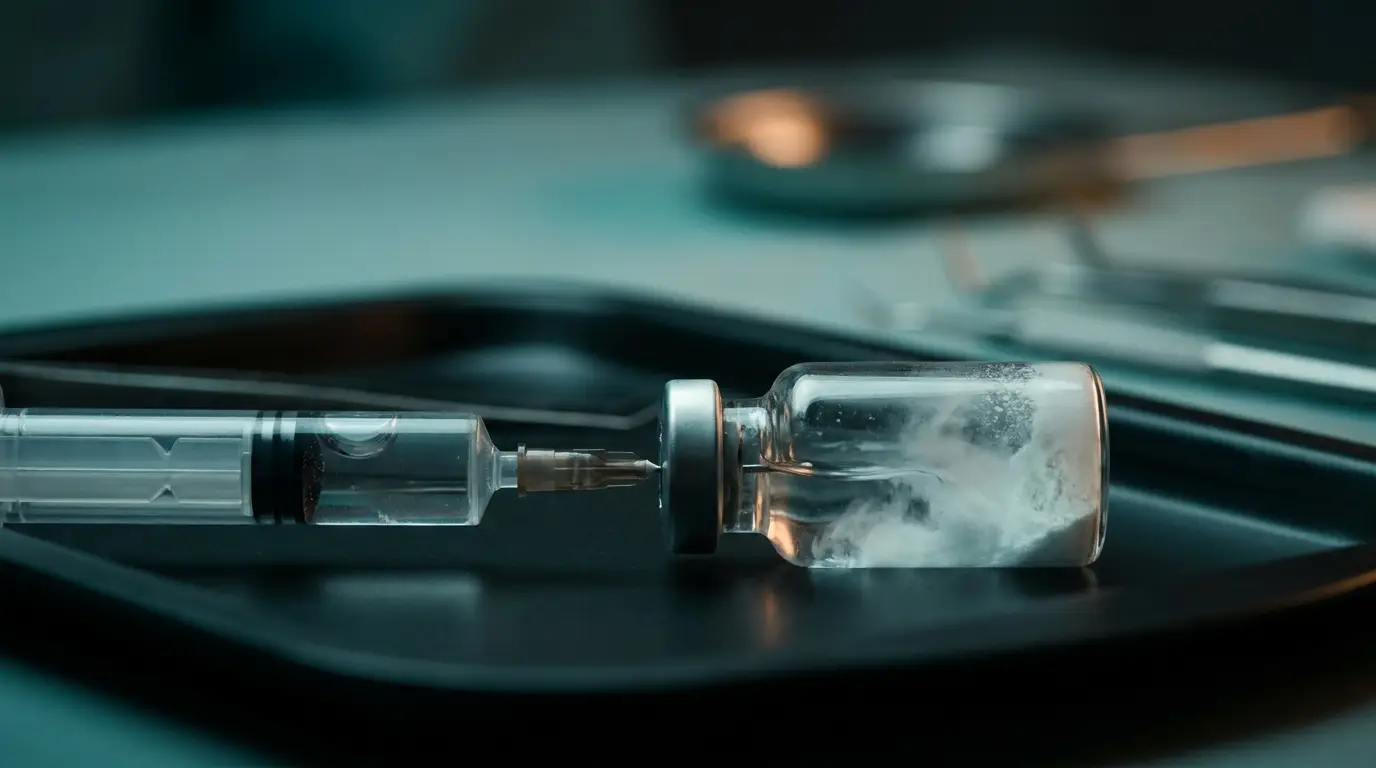
Next, draw your predetermined volume of bacteriostatic water into the syringe. The exact volume is the number you already calculated, the one that produces your intended concentration. Insert the needle into the peptide vial at a slight angle and, crucially, aim the stream of water against the inner glass wall of the vial rather than blasting it directly onto the powder. Peptides are delicate, and a forceful jet can shear and denature them. Let the water run gently down the side and pool at the bottom, dissolving the powder from beneath.
Once the water is in, do not shake the vial. Shaking introduces foaming and mechanical stress that can damage the peptide. Instead, set it down and let it sit, or swirl it with a slow, gentle rotation. Most well-made peptides dissolve within a minute or two into a clear, colorless solution. If after gentle swirling you still see visible undissolved particles, cloudiness, discoloration, or floating debris, that is a reason to stop and question the product rather than to push forward. A clean reconstitution looks like clear water.
Angle the stream, never blast the powder
Drawing a Measured Amount
Once the vial holds a clear, fully dissolved solution of known concentration, drawing a measured amount is a matter of translating your reference range into syringe units using the arithmetic from earlier. Wipe the stopper again with a fresh swab before every draw, this is not a one-time courtesy but a repeated discipline for the life of the vial. Draw slowly, tap out air bubbles, and read the plunger at eye level to avoid parallax error. If you overdraw, you can push the excess back into the vial rather than wasting it, provided you have maintained sterility throughout.
It bears repeating that the specific number of units is not something this article can or will hand you. That figure depends on your vial, your water volume, and above all the judgment of the licensed physician overseeing whatever protocol you are following. Reference ranges in the literature exist to give context, not to be copied blindly. The mechanical skill of drawing accurately is universal, the decision of what to draw is medical, and that decision is not yours or ours to make in a blog post.
Key takeaways
- The peptide mass in the vial is fixed, the concentration is something you create by choosing a water volume.
- Bacteriostatic water, not sterile-for-single-use water and never tap or distilled water, is the standard multi-use diluent.
- Add water gently against the glass wall, swirl, never shake, and expect a clear, colorless result.
- Cloudiness, particles, or discoloration are stop signs, not obstacles to power through.
- Every calculation and every dosing decision routes back to a licensed physician, not a forum post.
The Houston Variable: Heat, Humidity, and Cold Chain
Nowhere does storage discipline matter more than on the Gulf Coast. A Houston summer routinely pushes afternoon temperatures into the upper nineties with humidity that makes it feel worse, and the inside of a parked car in a Katy or Sugar Land lot can exceed 130 degrees within minutes. Peptides are temperature-sensitive biological molecules. Heat accelerates their degradation, and a vial that bakes on a doorstep for an afternoon or rides around in a hot glovebox may be compromised in ways you cannot see or taste. The clear solution still looks clear even as its potency quietly fades.
This is why cold-chain thinking should start the moment a shipment or pickup enters your day. If a package is arriving to a home in the Heights, Memorial, Pearland, or Clear Lake, plan to be there, or arrange for it to land somewhere shaded and cool rather than sitting in the sun on a July porch. Move refrigerated items to the refrigerator promptly. When you travel with a reconstituted vial across town, to a clinic near the Texas Medical Center, say, an insulated pouch with a cold pack is a reasonable precaution, keeping the vial cool but not frozen.
The parked-car mistake
General storage principles hold everywhere but bite harder here. Lyophilized powder is relatively stable and is typically kept cold and dark, often refrigerated, sometimes frozen for long-term storage depending on the specific peptide. Once reconstituted, the clock speeds up: the solution generally belongs in the refrigerator, protected from light, and used within a limited window of days to a few weeks depending on the peptide and the preservative. Write the reconstitution date on the vial or in your log so you are never guessing how old a solution is. In a climate this unforgiving, that date is your best defense against using something past its useful life.
Reconstitution is not a race. The powder has waited months to be dissolved, it can wait another minute while you check your math and your sterile field.
Sterile Technique Is the Whole Game
If concentration math is the intellectual half of reconstitution, sterile technique is the physical half, and it is non-negotiable. Bacteriostatic water suppresses bacterial growth, but it is not a license to be careless, it slows contamination, it does not undo it. Every time a needle pierces a stopper, that stopper should have just been wiped with alcohol and allowed to dry. Fingers never touch the cleaned surface. Needles are single-use and never recapped by hand in a way that risks a stick. Work surfaces are wiped down before you begin. These habits sound fussy until you remember that you are creating a solution that may be introduced into the body, at which point fussiness is simply respect for the stakes.
A related discipline is honesty about what you are handling. Research peptides sourced outside a regulated pharmacy pathway carry genuine uncertainty about identity, purity, and dose accuracy. No amount of perfect sterile technique fixes a mislabeled vial or an impure powder. This is one more reason the licensed-physician relationship matters, a clinician working through Texas-licensed compounding and telehealth channels operates in a regulated environment with quality expectations that an anonymous internet vendor does not. Sterile technique protects you from contamination you introduce, it cannot protect you from a product that was wrong before you ever opened it.
The Texas Telehealth and Compounding Context
Houston sits inside a large and active telehealth landscape, and Texas has its own framework governing how licensed providers and compounding pharmacies operate. Many Houston-area readers first encounter peptides through a telehealth consultation with a licensed clinician, followed by a prescription filled at a compounding pharmacy for those substances that can be legally compounded for a specific indication. That pathway, a real physician, a real evaluation, a regulated pharmacy, is worlds apart from ordering a research vial from an unknown website, both in legal standing and in product quality.
We deliberately do not name specific clinics, prices, or providers, and this site does not sell peptides or tell you where to source them. What we can say generally is that clinics around the Texas Medical Center and telehealth practices serving neighborhoods from The Woodlands to Galleria to Clear Lake operate within professional and legal obligations that an anonymous vendor simply does not have. If you are exploring peptides at all, the single most protective thing you can do is route the decision through a licensed Texas physician who can evaluate whether any of this is appropriate for you, and who can catch the interactions and contraindications that a first-timer cannot.
The peptides most commonly discussed in these conversations illustrate the range. BPC-157 is studied largely in animal and preclinical models for tissue and connective-tissue contexts and is not FDA-approved for human use. Ipamorelin is a growth-hormone secretagogue explored in research settings, again without human approval for general use. Tesamorelin is genuinely FDA-approved, but only for a specific HIV-associated lipodystrophy indication, its approval does not extend to the general wellness uses people sometimes imagine. Holding those distinctions clearly in mind is part of being an informed, adult reader rather than a hopeful one.
Common First-Timer Mistakes, Collected
Certain errors recur so often they are almost a rite of passage, which is precisely why they are worth naming so you can skip them. The first is shaking the vial, understandable, since we shake most things to dissolve them, but wrong for delicate peptides that shear under mechanical stress. The second is using the wrong water, reaching for distilled or plain sterile water when a multi-use protocol called for bacteriostatic. The third is skipping the alcohol swab after the first draw, treating sterility as a one-time setup rather than an ongoing discipline. The fourth is guessing at concentration instead of computing it, which produces syringe markings that are meaningless.
The fifth, and the most Houston-specific, is underestimating heat. People who are meticulous about their math still lose potency by letting a vial sit on a sunny counter or ride in a warm bag across the city. The sixth is failing to date the vial, so that a reconstituted solution lingers in the refrigerator for weeks past its useful window while the user assumes it is fine. None of these mistakes announce themselves, the solution looks identical whether you did everything right or several things wrong. That silence is exactly why the checklists and the second opinions matter.
Keep a boring little log
Where This Leaves You
Reconstitution, stripped of its mystique, is a small set of careful habits: use the right water, compute your concentration honestly, add the diluent gently, keep everything sterile, respect the Gulf-Coast heat, and write down what you did. The mechanics are learnable in an afternoon. What is not learnable from any article, ours included, is whether any given peptide is appropriate, safe, or legal for you specifically. That judgment belongs to a licensed physician who can weigh your history, your medications, and the real regulatory status of whatever is in the vial.
So treat this guide as exactly what it is, an educational orientation for adults 18 and older, written for research and informational purposes, from a site that does not sell peptides and will not tell you where to buy them. If it leaves you more careful, more skeptical, and more inclined to route your questions through a real Houston clinician rather than a forum thread, it has done its job. The powder can wait. Your safety is worth the extra minute, and then the extra phone call to someone qualified to actually advise you.
Frequently asked
What is reconstitution in one sentence?+
It is adding a sterile liquid, usually bacteriostatic water, to a freeze-dried peptide powder so it dissolves into a measurable liquid of known concentration. It does not change the amount of peptide, only makes it usable and measurable.
Why bacteriostatic water instead of regular sterile water?+
Bacteriostatic water contains a small amount of benzyl alcohol that suppresses bacterial growth, allowing a vial to be drawn from more than once over days or weeks. Plain sterile water for injection has no preservative and is intended for single use. Tap, distilled, or filtered water is never appropriate.
How do I know what concentration my vial is?+
You calculate it: divide the peptide mass stated by the manufacturer by the volume of bacteriostatic water you added. For example, 5 milligrams of peptide in 2 milliliters of water is 2.5 milligrams per milliliter. The same vial in 5 milliliters would be 1 milligram per milliliter. Have a licensed physician confirm your math.
Can I just copy someone's syringe unit number from a forum?+
No. Their unit number depends on their vial size and their water volume, which are probably different from yours. Only a reference range in micrograms or milligrams transfers between people, and even that is context, not a prescription. The conversion to syringe units is yours to compute and verify with a clinician.
How does Houston heat affect peptides?+
Heat accelerates degradation. A vial left in a hot car, on a sunny porch, or in a warm bag during a Gulf-Coast summer can lose potency invisibly, the solution still looks clear. Keep lyophilized and reconstituted peptides cold and out of the sun, and never use a parked vehicle as a temporary holding spot.
How long does a reconstituted peptide last?+
It depends on the specific peptide and the preservative, but reconstituted solutions generally belong in the refrigerator, protected from light, and are used within a limited window of days to a few weeks. Always write the reconstitution date on the vial so you are never guessing how old it is.
Are these peptides FDA-approved?+
Most are not. BPC-157 and ipamorelin, for example, are not FDA-approved for human use and are largely studied in animal or preclinical settings. A few peptides are approved but only for narrow indications, tesamorelin for a specific HIV-associated condition, for instance. This article is educational and research-purposes-only.
Does HTX Peptide sell peptides or tell me where to buy them?+
No. This site is an educational reference only. It does not sell peptides, recommend vendors, or provide sourcing guidance, and all content is intended for adults 18 and older. Any decision about using peptides should go through a licensed Texas physician.
What is the single most common first-timer mistake?+
Guessing at concentration instead of computing it, closely followed by shaking the vial instead of gently swirling it. Both are invisible errors, the solution looks the same either way, which is exactly why writing down your numbers and using a second set of eyes matters so much.
References
- Frid AH et al. — New Insulin Delivery Recommendations (injection technique and lipohypertrophy)Mayo Clin Proc 2016;91:1231-1255
- U.S. Pharmacopeia — Compounding Standards (USP General Chapters <795>/<797>)United States Pharmacopeia
- U.S. FDA — Compounding and the FDA: Questions and AnswersU.S. Food and Drug Administration
- U.S. FDA — Safely Using Sharps (Needles and Syringes) at Home, at Work and on TravelU.S. Food and Drug Administration
- CDC — Guideline for Hand Hygiene in Health-Care SettingsMMWR Recomm Rep 2002;51(RR-16)