If you have spent a July afternoon in Houston, you already understand the core problem this article addresses. A car left in a Katy parking lot can pass 140 degrees Fahrenheit inside the cabin. A package sitting on a Sugar Land porch bakes for hours before anyone brings it in. Humidity hangs at eighty and ninety percent for weeks. The Gulf Coast is one of the more demanding environments in the country for anything that has to stay cold, and temperature-sensitive peptides are exactly that kind of product. This guide walks through what the science actually says about peptide stability, how the Houston climate stresses it, and the practical handling questions people ask most, all framed for education and research discussion rather than as instructions to use any compound.
Before going further, the honest framing matters. The overwhelming majority of research peptides discussed in community and telehealth contexts are not approved by the U.S. Food and Drug Administration for human use. A small group is approved, but only for narrow, specific indications: semaglutide and tirzepatide for type 2 diabetes and chronic weight management, liraglutide for similar uses, tesamorelin for HIV-associated lipodystrophy, and PT-141 (bremelanotide) for a specific form of low sexual desire in women. Everything else, including popular names like BPC-157 and the growth hormone secretagogues, sits in a research-only category with no FDA sign-off for treating any condition in people. Nothing here is a recommendation to obtain or use these substances, and this site does not sell them.
Why Peptides Are So Temperature-Sensitive in the First Place
A peptide is a short chain of amino acids folded into a specific shape. That shape, and the intact chemical bonds holding the chain together, are what a molecule needs to do anything biologically. Heat, light, oxygen, and moisture all degrade peptides through predictable chemistry. Warmth speeds hydrolysis, where water breaks the peptide bonds, and accelerates oxidation and deamidation, reactions that quietly alter individual amino acids. Some peptides also aggregate, clumping into inactive or potentially problematic forms when stressed. The result of all this is not usually a dramatic color change you can see. A degraded peptide often looks identical to a fresh one, which is precisely why careful handling matters more than eyeballing a vial.
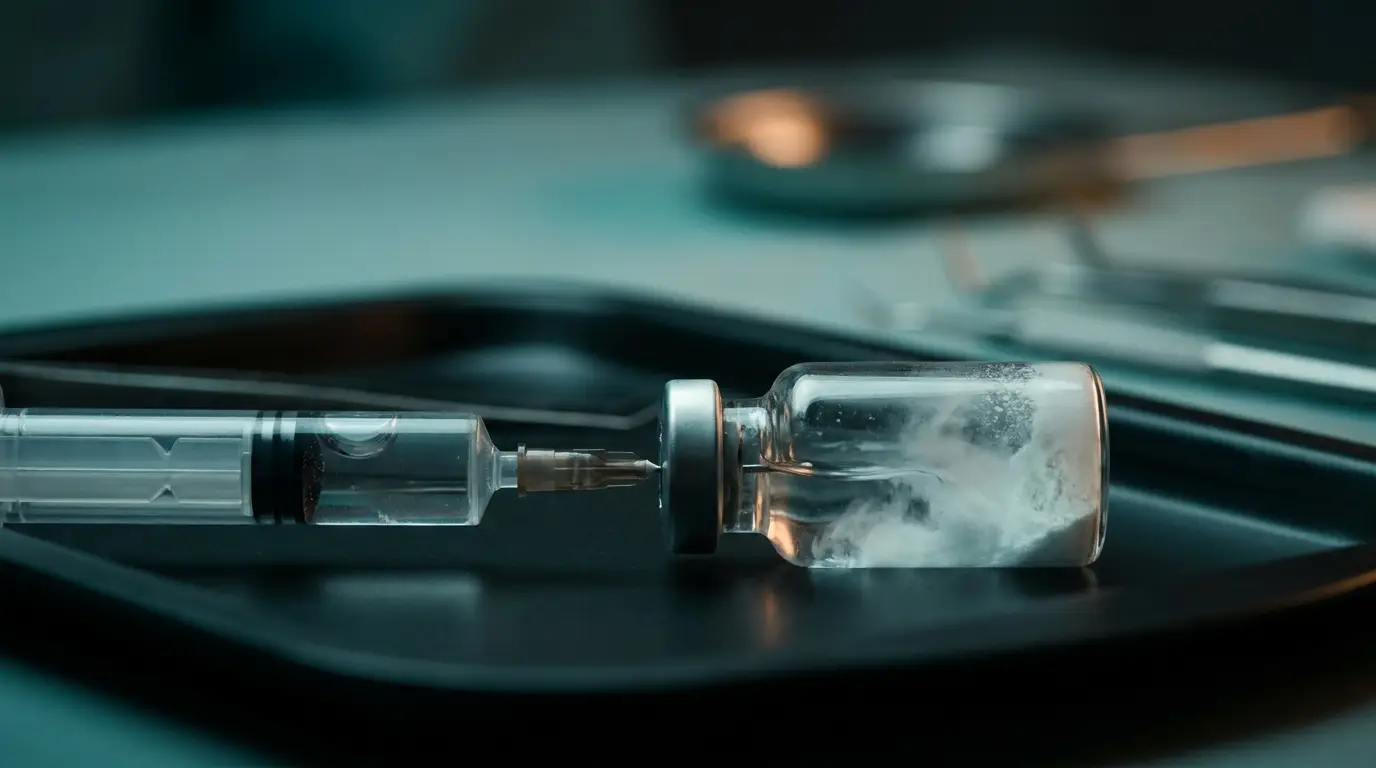
The single most important stability fact is the difference between the lyophilized powder and the reconstituted solution. Lyophilization is freeze-drying, a process that removes nearly all water and leaves a fluffy or crystalline solid. Without free water available to drive hydrolysis, a lyophilized peptide is dramatically more stable than the same peptide dissolved in liquid. Manufacturers of research materials routinely note that many lyophilized peptides tolerate short periods at room temperature and can be stored for extended periods when kept cold and dry. The moment you add bacteriostatic water and reconstitute, the clock speeds up considerably, because the molecule is now swimming in the very solvent that degrades it.
Degradation Is Usually Invisible
What the Houston Climate Actually Does to Cold-Chain Products
Cold chain is the logistics term for keeping a temperature-sensitive product within a safe range from origin to end use. Hospitals around the Texas Medical Center run some of the most sophisticated cold-chain operations in the world for vaccines, biologics, and blood products, precisely because Houston makes it hard. The ambient heat means any lapse, an unplugged cooler, a delayed delivery, a warm loading dock, erodes a product faster here than it would in Denver or Seattle. The lessons those professionals apply at institutional scale translate directly to the everyday handling questions people have at home.
Consider the delivery leg alone. A cold-shipped package typically travels with gel packs or dry ice rated for a certain number of hours. Those hours were calculated for average conditions, not for a box that sits on a Pearland doorstep in direct sun while the interior of the porch reads well over 100 degrees. By the time a package has spent an afternoon outdoors in August, the insulation may be long exhausted and the contents warm. This is why many Houston residents who receive any cold-shipped item, from groceries to medications, arrange to bring packages in immediately or ship to an address where someone is present.
Then there is the car. A vehicle is the worst place imaginable to stage a temperature-sensitive product in a Houston summer. Cabin temperatures climb astonishingly fast, and even a quick errand chain, the Galleria, then Memorial, then home, can expose a vial to sustained heat far outside any reasonable range. A small insulated bag with a cold pack turns a risky transport into a manageable one, and it is a cheap habit that mirrors how the pros move biologics across the medical center.
Treat the Porch and the Car as Ovens
Storing the Lyophilized Powder
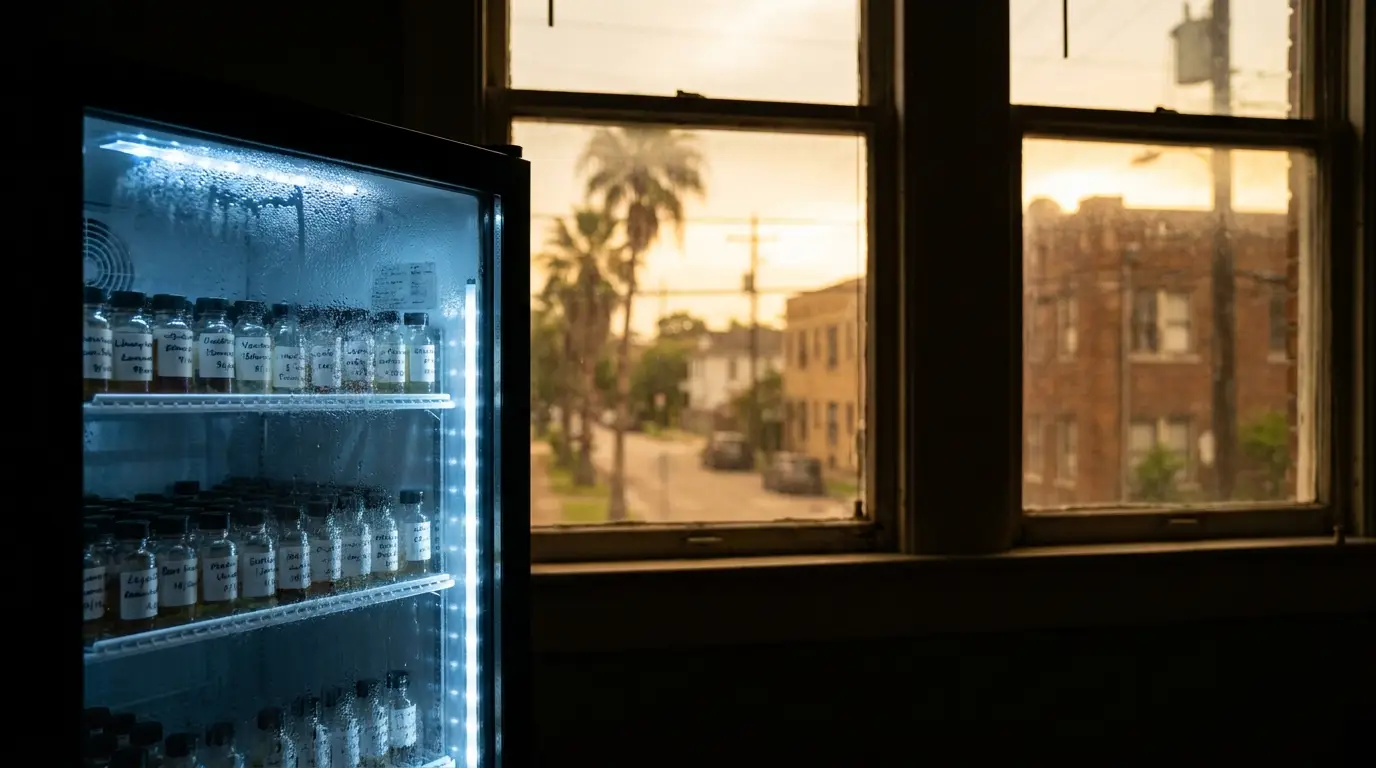
For an unopened, freeze-dried vial, cold and dark are the goals. General guidance seen across research-supplier documentation is that long-term storage of lyophilized peptides is best in a freezer, often cited around minus 20 degrees Celsius, with refrigeration as a suitable option for shorter horizons. Many powders tolerate brief room-temperature exposure during shipping without meaningful loss, which is why cold shipping is designed to prevent prolonged warmth rather than to guarantee a single degree. Keeping the vial in its packaging or an opaque container limits light, and keeping it dry limits the humidity that Houston has in abundance.
Humidity deserves special attention on the Gulf Coast. A lyophilized powder is hygroscopic, meaning it readily pulls moisture from the air. Opening a cold vial in a humid kitchen can cause condensation as warm, wet air meets the chilled glass, introducing exactly the water you were trying to keep out. Letting a vial come closer to room temperature before opening, and minimizing the time the stopper is exposed, reduces this. In a city where indoor humidity can stay high even with air conditioning, these small steps matter more than they would in a dry climate.
Freeze-Thaw Cycling Is Cumulative Damage
Reconstitution and the In-Use Window
Reconstitution means dissolving the powder in a sterile diluent, most commonly bacteriostatic water, which contains a small amount of benzyl alcohol to inhibit microbial growth across multiple punctures of the stopper. The bacteriostatic component is why this diluent is favored for multi-dose scenarios over plain sterile water. Community and compounding-pharmacy references generally treat a reconstituted peptide as a refrigerated product with a limited useful life, often discussed in the range of a few weeks, with the exact window depending heavily on the specific peptide, its concentration, the diluent, and how carefully sterility was maintained.
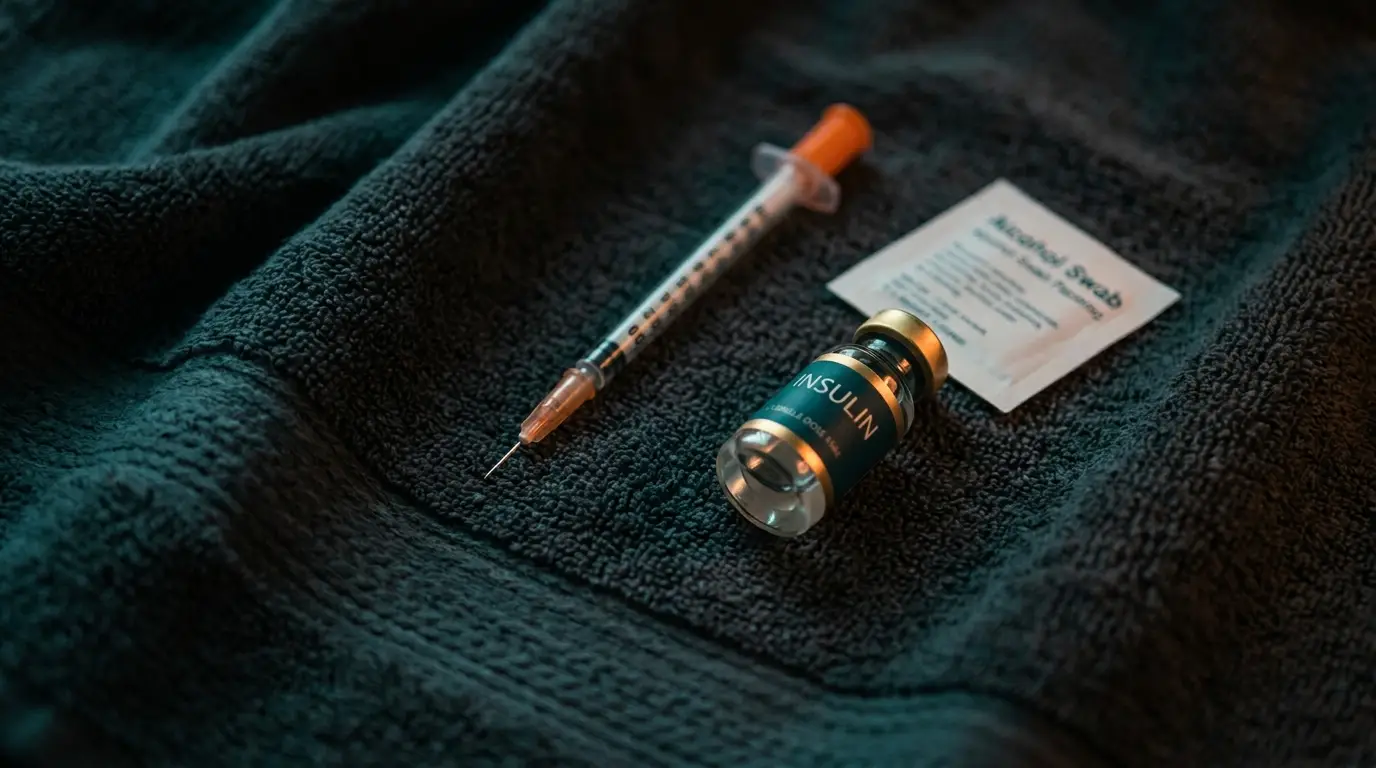
The technique details that circulate in protocols exist mostly to protect the molecule and the sterility of the solution. Adding the diluent slowly against the inside wall of the vial rather than blasting it directly onto the powder reduces mechanical stress and foaming. Swirling gently rather than shaking hard avoids shearing and aggregation for peptides prone to it. Wiping the stopper with alcohol before each puncture and using a fresh needle limits contamination. None of this is presented here as an instruction to prepare or use anything; it is context for understanding why storage and handling are discussed the way they are.
Label the Vial With the Date You Mixed It
Concentration and diluent choice also interact with stability in ways worth understanding conceptually. More dilute solutions and certain diluents can shorten or lengthen the practical window, and some peptides are simply more fragile than others once wet. This variability is exactly why blanket rules are unhelpful and why any real decision about a specific compound belongs with a licensed physician or pharmacist who can speak to that molecule, not to a general article.
Key takeaways
- Lyophilized powder is the stable form; reconstituted solution is the fragile, time-limited form.
- Cold and dark for the powder; refrigeration and a tracked in-use window for the solution.
- Houston's heat, humidity, and outages compress every safety margin that cooler climates take for granted.
- Freeze-thaw cycling causes cumulative damage, so storage stability matters as much as storage temperature.
- Specifics vary by peptide; a physician or pharmacist, not a blog, resolves any individual case.
Traveling With Peptides in and Out of Houston
Travel multiplies every storage challenge because you lose the steady refrigerator that anchors home storage. The general principle people apply is to keep temperature-sensitive items with them rather than in checked baggage, since cargo holds and the tarmac at a summer-hot airport swing wildly in temperature. An insulated travel case with cold packs, sized to the trip length, is the standard approach for keeping items cool through a flight and ground transport. For a drive from Houston to the Hill Country or the coast, the same insulated-cooler logic applies, with the added reminder never to leave the cooler baking in a parked car at the destination.
Air travel adds a documentation dimension. For genuinely prescribed medications, travelers commonly carry them in original labeled packaging with a copy of the prescription, and security screening policies in the United States generally allow medically necessary liquids and gel packs beyond ordinary carry-on liquid limits when declared. Research compounds without a prescription do not fit that framework, which is one more reason the whole topic routes back to working within a legitimate, physician-directed context rather than improvising. International travel introduces customs and import rules that vary enormously by country and can carry serious legal consequences, so anything crossing a border is a question for qualified legal and medical guidance, not a checklist.
- Insulated case sized to trip length, with enough cold packs to cover the longest gap between refrigeration.
- Items kept in the cabin with you, never in a checked bag or a cargo hold.
- Original labeling and prescription documentation for anything genuinely prescribed.
- A plan for refrigeration at the destination, so a hotel mini-fridge is confirmed before you rely on it.
- No temperature-sensitive vial ever left in a parked vehicle, at home or away.
Hurricane Season and the Power-Outage Problem
Houston's relationship with power outages is not hypothetical. Hurricane season runs June through November, and the region has seen multi-day and even multi-week outages after major storms and derechos in recent years. For anyone relying on refrigeration to keep a temperature-sensitive product viable, a prolonged outage is a direct threat. The same planning that protects insulin and other refrigerated medications applies to any cold-stored peptide, and it is worth thinking through before a storm is in the Gulf rather than during the scramble.
A closed refrigerator holds its temperature for a few hours and a full freezer for roughly a day or two if the door stays shut, which is why the standard advice during outages is to open them as little as possible. Beyond that window, coolers with ice, and being realistic about how long ice lasts in Houston heat, become the fallback. People who depend on refrigerated medications often keep an insulated cooler and a plan for sourcing ice ready before hurricane season, and some invest in a small battery or generator specifically to keep a refrigerator running. The honest truth is that after a certain number of warm hours, a temperature-sensitive product may simply no longer be trustworthy, and the safe assumption is to treat questionable items as compromised.
When in Doubt After an Outage, Do Not Assume Viability
The Houston Telehealth and Compounding Context
Texas has a large and active telehealth market, and Houston sits at the center of it. Many residents encounter peptides through telehealth providers and compounding pharmacies, particularly for the FDA-approved GLP-1 medications used in weight management. Compounding pharmacies prepare medications to order and operate under state and federal oversight, and a legitimate compounded product for an individual patient is a different thing entirely from an unregulated research vial. When a peptide reaches someone through a licensed prescriber and a licensed pharmacy, that chain includes storage guidance, labeling, and a professional to call with questions, which is exactly the infrastructure that ad hoc arrangements lack.
This distinction is worth holding onto because it shapes the storage conversation. A patient receiving a compounded, prescribed medication should follow the specific storage instructions on the label and from the pharmacy, full stop. Those instructions supersede any general article, including this one. The broader research-peptide discussion, covering the many compounds that are not approved and not prescribed, is educational, and the appropriate move for anyone considering that space is a conversation with a licensed physician who can weigh the real and substantial unknowns, not a decision made from a storage guide.
It also bears repeating that the popularity of a compound says nothing about its regulatory status or its safety. BPC-157 and the growth hormone secretagogues such as ipamorelin are widely discussed online yet remain research chemicals without FDA approval for human use, and their long-term safety in people is not established by rigorous human trials. The GLP-1 agents like semaglutide have extensive human trial data behind their approved uses, which is a categorically different evidence base. Conflating the two is one of the most common mistakes in this space.
Storage habits cannot rescue a product from a category built on uncertainty; they can only protect what a physician has already deemed appropriate.
Evidence Grading: What We Actually Know
It is worth being explicit about the quality of evidence behind the claims in this article, because evidence grading is central to how HTX Peptide approaches every topic. The general chemistry of peptide degradation, hydrolysis, oxidation, deamidation, and aggregation accelerating with heat and moisture, is well established laboratory science and applies broadly to peptides and proteins. The superiority of the lyophilized form over solution for stability is likewise standard pharmaceutical knowledge. These are high-confidence, mechanism-level facts.
The specific numbers that circulate in community protocols, a given peptide lasting a certain number of weeks reconstituted, or tolerating a certain number of hours at room temperature, are far softer. Much of that guidance comes from supplier documentation and user experience rather than peer-reviewed stability studies on each individual compound. It is reasonable as general orientation and unreliable as a precise rule for any particular vial. Where human clinical data exists, as with the approved GLP-1 medications, storage guidance comes from regulated product labeling and is trustworthy for those specific products. For the large research-only category, treat all storage specifics as informed estimates, not established fact, and route real decisions to a professional.
Finally, none of the dosing or protocol references that appear anywhere in peptide discussion should be read as a prescription. When ranges are mentioned in the literature or in community settings, they describe what has been observed or reported, not what anyone should do. The gap between a reference range and a personal decision is filled by a licensed physician who knows your history, and that is a gap no article can or should try to close. This piece is for adults 18 and older, is educational only, and offers no sourcing or purchasing guidance of any kind.
Houston's climate makes careful thinking about temperature-sensitive products a practical necessity rather than an abstraction. Whether the item in question is an approved, prescribed medication from a compounding pharmacy near the Texas Medical Center or a compound someone is merely reading about, the same physical realities apply: heat, humidity, light, and time are the adversaries, and steady cold storage is the defense. Understand the science, respect the Gulf Coast environment, keep the FDA-approval distinctions straight, and let a qualified professional make the calls that matter. That is the whole of responsible, educational engagement with this subject.
Frequently asked
Does the Houston heat really degrade peptides faster than in cooler cities?+
Yes, in the practical sense that every temperature lapse does more damage in a hot, humid environment. The underlying degradation chemistry is temperature-driven, so higher ambient heat during delivery, transport, or an outage erodes a product faster than it would in a cooler climate. Steady refrigeration at home is the same everywhere; it is the gaps, porches, cars, warm loading docks, that Houston makes worse.
What is the difference between the powder and the reconstituted solution for storage?+
The lyophilized (freeze-dried) powder is far more stable because it lacks the free water that drives degradation, and it is generally stored cold and dark, often frozen for long horizons. Once reconstituted with bacteriostatic water, the peptide is dissolved in the very solvent that breaks it down, so it is treated as a refrigerated item with a limited in-use window of roughly a few weeks, depending on the specific compound.
Are the peptides discussed here FDA-approved?+
Most are not. The large majority of research peptides, including BPC-157 and growth hormone secretagogues like ipamorelin, are not FDA-approved for human use. A small group is approved only for specific indications: semaglutide, tirzepatide, and liraglutide for diabetes and weight management, tesamorelin for HIV-associated lipodystrophy, and PT-141 for a specific sexual desire disorder. This article is educational and does not recommend use.
How should I handle a cold-shipped package in the Houston summer?+
The goal is to minimize time spent warm. Many residents arrange delivery for when someone can bring the package inside within minutes, or ship to an address where a person is present, rather than letting it bake on a porch. Cold-shipping insulation is designed to buy hours, not days, so an afternoon in the sun can exhaust it entirely.
What happens to my refrigerated items during a hurricane-season power outage?+
A closed refrigerator holds temperature for a few hours and a full freezer for a day or two if kept shut, after which coolers with ice are the fallback, though ice does not last long in Houston heat. For prescribed medications, contact your clinic or pharmacy about replacement if items spent an unknown time warm. Treat questionable items as compromised rather than assuming they survived.
Can I travel with peptides on a flight out of Houston?+
General practice for temperature-sensitive items is to keep them in the cabin in an insulated case with cold packs, never in checked baggage, and to carry documentation for genuinely prescribed medications in original labeling. Research compounds without a prescription do not fit medical-necessity screening frameworks, and international travel adds customs rules with serious legal consequences, so anything crossing a border is a question for qualified legal and medical guidance.
Is it safe to leave a vial in my car for a quick errand?+
No. A parked car in Houston can exceed 140 degrees inside within minutes, which is far outside any safe range for a temperature-sensitive product. Even brief exposure is a real risk. An insulated pouch with a frozen gel pack is the simple fix for the transport-and-errands gap between roughly May and October.
Does a peptide look different once it has degraded?+
Usually not. Degradation is typically invisible; a compromised peptide often looks identical to a fresh one. Cloudiness, particles, or a color change are reasons to discard, but their absence does not prove potency or sterility. This is one reason the research-only category carries uncertainty that no home inspection can resolve.
Is any of this medical advice I can act on?+
No. This article is educational and for adults 18 and older only. It is not medical advice, not a prescription, and not sourcing guidance, and this site does not sell peptides. Storage and dosing specifics vary by compound, and any real decision belongs with a licensed physician or pharmacist who knows your individual situation.
References
- U.S. Pharmacopeia — Compounding Standards (USP General Chapters <795>/<797>)United States Pharmacopeia
- U.S. FDA — Compounding and the FDA: Questions and AnswersU.S. Food and Drug Administration
- Frid AH et al. — New Insulin Delivery Recommendations (injection technique and lipohypertrophy)Mayo Clin Proc 2016;91:1231-1255
- Sikiric P et al. — Stable gastric pentadecapeptide BPC 157 (review)Curr Pharm Des 2018;24:1990-2001
- World Anti-Doping Agency — The Prohibited List (International Standard)WADA (current edition)